Our network
Counties Energy owns and operates the electricity distribution network that runs from coast to coast between southern Papakura and Mercer, and west of the Waikato River from Mercer to Waikaretu. While our business transitions into a smarter energy system in line with rapid technological advancements and changing consumer preferences, our network will always be its foundation.
How we use energy as a community and as a country is changing. The way our energy is generated is also on a new trajectory, one that protects our future environment and generations. To meet these changes, we must innovate to ensure our community thrives. As a consumer-owned electricity distribution company, we’ll continue to make much broader decisions across our network and beyond, in a smarter, safer and more sustainable way.

Our substations
As an electricity distribution company, Counties Energy receives power from the transmission system (operated by Transpower) at voltages of either 110kV or 33kV and transports this to nine different substations.
The substations then convert the electricity to different voltages, either 22kV or 11kV, before this is distributed to homes and businesses on our network.
Our substations are located at Opaheke, Ramarama, Pukekohe, Karaka, Waiuku, Maioro, Pokeno, Tuakau and Mangatawhiri.
Geospatial data
Geospatial maps provide an overview of our electricity distribution network. Here you’ll find location of zone substations, names of feeders connected to it, the input and output voltages it primarily transforms, and the boundary of the area it serves, provided in a standard GIS format.

What types of power lines are there?
There are three main types of power lines: transmission, distribution, and service lines. Transmission lines form part of the national grid and are owned by Transpower, while distribution lines are owned by local electricity companies like Counties Energy. Even if these lines run across your property, you won’t be responsible for them.
Service lines are different. These are the lines that connect the local network directly to homes and businesses. Ownership of service lines isn’t always obvious and can depend on how the line is set up.
If a service line only supplies your property and is located on your land, it’s likely that you own it. If the line supplies multiple properties, ownership may be shared with others or may sit with the electricity distributor.
The grey and blue lines on these diagrams represent the parts of the service lines (which are located inside the boundary of your property) that you own and are responsible for.
Who owns the lines?
Property owners are responsible for maintaining and repairing electrical lines on their property.
In most cases, you are responsible for the power line that runs from your home or building to where it connects to the electricity network. This means you are responsible for maintaining and repairing any lines or equipment that are not part of the Counties Energy network.
Ownership can sometimes be complex. It depends on factors like:
- Agreements in place when the line was built;
- Legal arrangements tied to your property;
- Whether the line also supplies electricity to neighbouring properties.

Why does ownership matter?
If you own a service line, you’re responsible for its maintenance and repair. This can also include related equipment such as poles and cables.
For most urban properties, this responsibility is minimal. However, for rural properties where lines can stretch several kilometres, maintenance can be more significant.
As the owner, you may need to:
- Arrange repairs if the line is damaged
- Maintain the line to ensure it remains safe
- Remove the line if it’s no longer needed
- Cover any costs associated with these works
You could also be responsible for damage caused by the line to your property or others.

Who maintains vegetation around lines and electrical equipment?
If you have trees or vegetation growing near a service line on your property, it’s your responsibility to keep them trimmed to prevent interference with the power supply.
Counties Energy will carry out the ‘first cut’ of a tree near network power lines for free, then the owner is responsible and liable for the costs of any future maintenance of the tree to ensure it does not encroach on the Notice Zone.
Keeping trees and vegetation trimmed not only helps keep your power supply safe and reliable, but also helps you avoid potential penalties.
Power lines and power poles
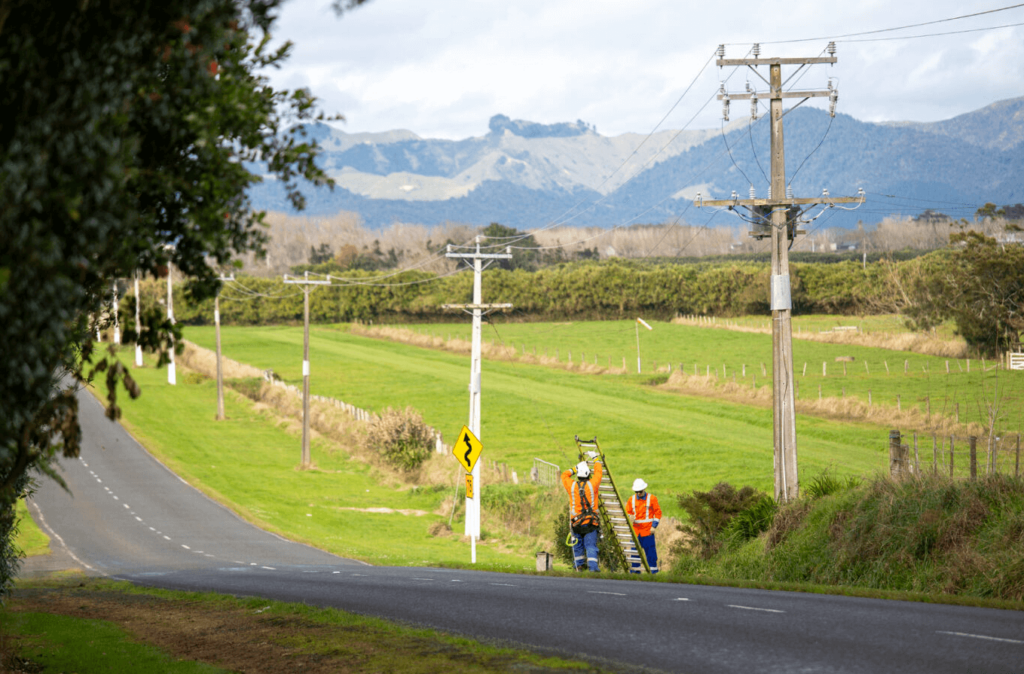
This is the most visible part of any distribution network and can be seen on most roads in New Zealand. Given the rural nature of our network, we have mostly overhead power lines and poles, with just 10% of the network underground.
Transformers
Power is transported at high voltage for efficiency and transformed to lower voltages as it gets closer to its destination. There are around 3,100 pole-mounted transformers and 635 ground-level transformers on our network.
Network control
To ensure the safe and efficient flow of electricity to homes and businesses daily, we have a team of network controllers who monitor and manage our network 24/7 remotely.
If you’re unsure who owns a line on your property or what your responsibilities are, get in contact us. Understanding your ownership can help you avoid unexpected costs and ensure your power supply remains safe and reliable.